What You Should Know—and Probably Don’t—about America’s Wild Horses
Wild horses have long been an iconic symbol of the American West, representing strength, resilience, independence, and freedom. But these majestic sentient beings are facing a devastating crisis and desperately need our help.
My latest Substack article. Click link or read here.
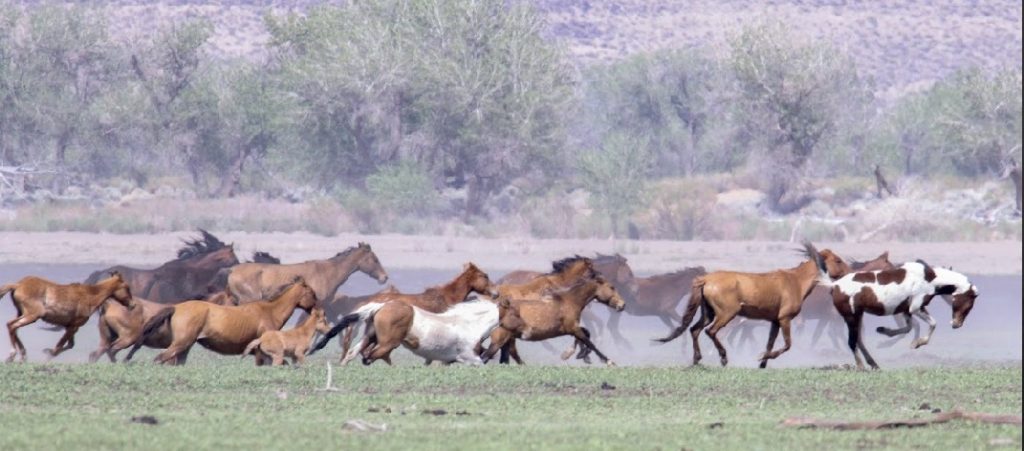
Photo: Lahontan (NV) AWHC/Steve Paige
(This essay is meant as a general overview of the current plight of America’s wild horses. Each paragraph could be elaborated on in detail, which I may do separately in future essays. But for now, my point is to briefly introduce the facts, the problem, and what is being done to help.)
The Facts
According to the Bureau of Land Management, there are approximately 73,000 mustangs and burros living wild and free on government-designated land—Herd Management Areas (HMAs)—in ten western states: Nevada, Wyoming, Oregon, Idaho, Utah, Arizona, California, Montana, Colorado, and New Mexico. These lands are often unwanted lands, too dry or rocky to farm or log. Yet wild horses have not only survived, they thrive, due to their toughness, resilience, and connected family bands—exactly what makes them emblematic of our nation.
The Problem
Unfortunately, the Bureau of Land Management (BLM), responsible for protecting them, rounds up thousands of wild horses and burros every year, breaking apart bonded families (even mares from foals), wrenching them from their homes, and taking away their freedom forever.
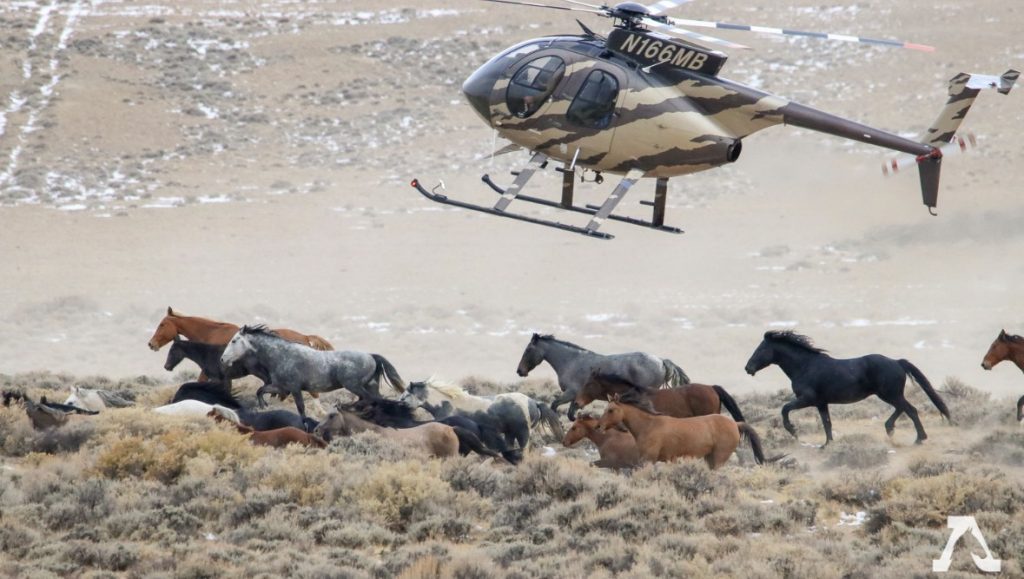
Photo: AWHC
Roundups are often done by helicopter, chasing the terrified horses for miles, forcing them into a chute and pen, where they are separated, stallions from mares from foals, loaded into crowded trailers, and shipped to long-term holding and an uncertain future. Many horses are injured or die in the process, especially foals who suffer what is called capture myopathy, heart failure due to extreme stress and the long distances they are forced to run during roundups.
The first roundup of 2026 in Nevada’s Owyhee Complex resulted in 7 deaths and 173 captured and sent to holding pens, but the BLM is planning another massive roundup in Nevada’s Callaghan Complex where close to 5,000 horses may lose their freedom.
Why are they rounding up our wild horses and burros?
The BLM’s reason is to reduce them to “appropriate management levels” to keep both the equines and the environment healthy and sustainable. A claim that is generally unfounded, masked behind a harsher truth.
Livestock and wild equines compete for resources on public land, but horses are often stated as the primary cause of environmental degradation, and thus the reason for removal. Yet livestock grazing (cattle and sheep) is the main cause of land degradation—not horses. According to American Wild Horse Conservation, “A congressionally-mandated study by the National Academy of Sciences found that, in one year, livestock consumed 70% of grazing resources on public lands, while wild horses and burros consumed less than 5%.” Despite this fact, the power of the livestock industry takes precedence as the BLM bends to their wishes. Better management by the BLM and appropriate allocation of resources would allow our wild horses to live wild and free.
As for the statement that mustangs and burros are starving due to drought conditions or overgrazing of lands,advocates that witness and photograph wild horses both in the field and at roundups confirm that the equines are in excellent body condition, not malnourished. At least not until they are crammed into trailers and taken to desolate holding pens, where they live in dismal, crowded conditions, often indefinitely—the complete opposite of the life of movement and freedom in the wild they have always known.
Right now, there are about 62,000 wild horses and burros trapped in long-term holding with plans for BLM to remove approximately 20,000 more.
What about adoption?
While some mustangs are adopted through the BLM and end up in good homes (though still separated from their families and not wild and free), many end up in the wrong hands. The well-intentioned Adoption Incentive Program, which paid the adopter one thousand dollars at the end of a year of ownership, turned into a massive disaster. Greedy adopters took as many horses as they could, kept them in neglectful conditions for the year, then as soon as they received their title and money, sent the horses to auction where they were often sold to kill buyers and sent to slaughter houses in Mexico and Canada. Fortunately, wild horse advocates fought for an end to this program, providing evidence of repeated abuse. The Adoption Incentive Program was discontinued as of March 2025.
However, a new adoption abuse is slowly rising as a result of the BLM’s need to find a solution to those thousands of horses they have in holding. Changes to Sale Authority (horses over ten years of age or passed over three times for adoption, eligible for unrestricted sale) are leading to the same problem of large numbers being adopted without oversight and ending up in the slaughter pipeline. Wild horse advocates are fighting to resolve this issue as well.
What Can Be Done to Help Our Wild Horses and Burros?
- Stop the roundups.
- Use PZP fertility control, a scientifically proven, safe, and humane approach to keep wild horse populations in check.
- Pass the SAFE Act, Save America’s Forgotten Equines, H.R. 1661/S.775 to stop the illegal sale and shipping of equines to slaughter.
- Pass the Ejiao Act H.R. 5544 Stop the sale of ejiao and save donkeys.
- Donate to organizations leading the legal fight, such as American Wild Horse Conservation
- Work with the livestock industry for fair and appropriate allocation of resources on our public lands.
- Support wild horse rescues and sanctuaries.
Humane Fertility Control: PZP
There is a safe and proven form of fertility control for equines called PZP, Porcine Zona Pellucida, administered by remote darting. PZP is an effective equine fertility vaccine that does not affect a mare’s hormonal balance or disrupt normal behaviors. The effectiveness of this vaccine has been proven in Nevada’s Virgina Range, where there has been a 72% decline in births since their program began in 2019. Assateague Island National Seashore and McCullough Peaks HMA have also successfully implemented its use. PZP vaccine is cost effective, $30 per vaccine, significantly less than the excessive costs of roundups and holding pen expenses.
Unfortunately, the BLM often uses GonaCon, an immunocontraceptive vaccine that reduces sex hormones and drastically affects normal animal behaviors. PZP is the better option for fertility control for it is effective and does not interfere with normal behaviors.
Pass the SAFE Act, Save America’s Forgotten Equines H.R. 1661/S.775 A bipartisan bill
Specifically, this bill prohibits a person from knowingly (1) slaughtering an equine for human consumption; or (2) shipping, transporting, possessing, purchasing, selling, or donating an equine to be slaughtered for human consumption or equine parts for human consumption.
Contact your representatives, Capitol Switchboard (202) 224-3121, and ask them to pass the SAFE Act.
Ejiao Act H.R. 5544
Millions of donkeys are slaughtered for the collagen in donkey skin to produce ejiao, a key ingredient used in Chinese medicines—none of which are considered truly effective products. If demand for ejiao is not stopped, the donkey population could be significantly decimated. Please contact your representative and ask them to support this act. This link will guide you to take action. https://www.brookeusa.org/ejiao-act#/
Sanctuaries and Rescues
There are many outstanding rescues that save horses and burros from the slaughter pipeline and give them back a semblance of freedom where they can roam on acres of land (some larger than others). One in particular, and the gold standard in rescue, Skydog Ranch and Sanctuary, (California and Oregon) goes so far as to find and reunite family members when possible. Oscar’s Place (California) focuses on donkeys. All have faithful followers on social media who donate repeatedly to help fund the enormous expenses involved in rescue, from cost of purchase at auctions, transport, vet care, food, etc.
There are many rescues on FB and IG and they are a joy to follow. Uplifting. Heartwarming. Sure to lift your spirits.
Sadly, rescues cannot keep up with the number of horses rounded up year after year. Roundups must stop.
Some Progress Made, But Much More Needed
Wild horse advocates have worked tirelessly. Thanks to their unrelenting pursuit of justice for wild horses, some progress has been made. The Interior Appropriations bill was recently passed, which includes protection against slaughter and provides $11 million for immunocontraceptive vaccines for fertility control, not permanent sterilization.
Congresswoman Dina Titus (D-NV), a longtime wild horse advocate, was instrumental in forming the Wild Horse Caucus to fight for our horses on a federal level. Co-chairs of the bipartisan caucus are Rep. David Schweikert (R-AZ), Rep. Steve Cohen (D-TN), and Rep. Juan Ciscomani (R-AZ).
However, to what extent the BLM will implement these measures is unclear. This does not stop the roundups, nor does it stop the increasing Sale Authority adoptions that put mustangs and burros into the wrong hands and illegally into the slaughter pipeline. Use of PZP over GonaCon is crucial in maintaining humane fertility control. Better management and oversight of the BLM is imperative.
And So the Fight to Protect Our Wild Horses Continues
You can keep informed by signing up for email updates with American Wild Horse Conservation (Click link, Scroll down to bottom.) I encourage you to follow horse and donkey rescues on social media. They will put a smile on your face daily. Donate if you can to AWHC or to rescues and sanctuaries that you might connect with. The need is great and even the smallest amount adds up.
Our wild horses and burros don’t belong in long term holding pens, forever separated from their families, or worse, on trailers headed to slaughter. They belong on our public lands with their fiercely bonded family bands, running wild and free.
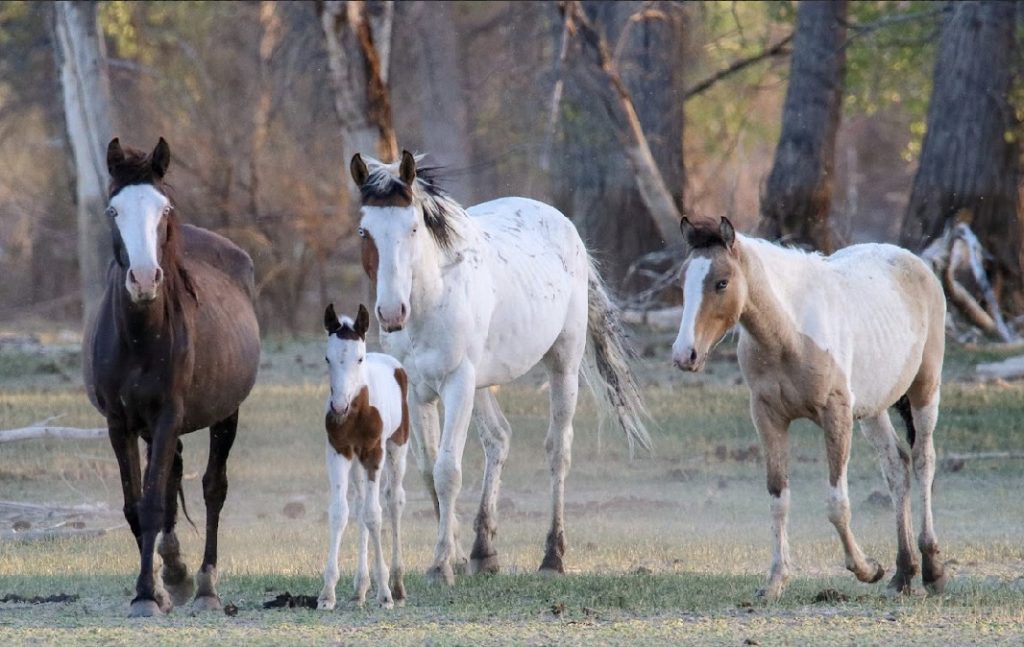
Photo: Lahontan (NV) AWHC/Steve Paige
Further Reading
- Best Book to learn more about our wild horses is Wild Horse Country by David Philipps
- Best Blog and Podcast— Carol Walker’s Wild Hoofbeats . Website includes stunning photography, blog, and podcast link: Freedom for Wild Horses
- Best source for current info. American Wild Horse Conservation (AWHC) https://americanwildhorse.org/
A national organization that champions the humane treatment of wild horses and burros. They work in all areas listed above—in the field, in the courts, on the Hill, on the page—to protect wild horse and burros. I’m proud to be a Volunteer Ambassador for AWHC.